A field monitor with SDI can make professional camera feeds easier to view, assess, and share on set. Compared with HDMI-only displays, SDI models are often better suited to longer cable runs, broadcast workflows, and demanding production environments.
These 10 options cover compact camera-top monitors, bright daylight screens, touchscreen models, and larger broadcast displays. The right choice depends on your camera outputs, viewing conditions, monitoring tools, and how portable your setup needs to be.
Best 10 Field Monitor with Sdi Picks for 2026
Best Sunlight-Readable Pick

- 2000-nit 6-inch IPS display
- 3G-SDI and 4K HDMI loop-out
- Waveform, LUT, and focus tools
Best For: Outdoor shoots and demanding all-day production
Best OLED Workflow

- 7-inch 1200-nit OLED touchscreen
- 4K HDMI and 3G-SDI I/O
- Includes two NP-F750 batteries
Best For: On-set monitoring with a larger OLED display
Best Large Production Monitor

- 17.3-inch 1080p display
- 3G-SDI, HDMI, composite, and component I/O
- Front and rear three-color tally lights
Best For: Broadcast and shared-view production setups
Best 12G-SDI Compact Pick

- 12G-SDI and 4K HDMI at 60fps
- 1200-nit touchscreen display
- Lightweight aluminum body with accessories
Best For: Mobile 4K camera rigs needing high-speed SDI
Bright Studio Monitoring
FEELWORLD FVM215 21.5-inch SDI Monitor

- 21.5-inch 1000-nit IPS display
- 3G-SDI and HDMI connectivity
- Waveform, vectorscope, false color, and 3D LUT tools
Best For: Studio and broadcast crews needing a large, bright monitor
Touchscreen Field Flexibility
VILTROX DC-L2 7-inch SDI Monitor
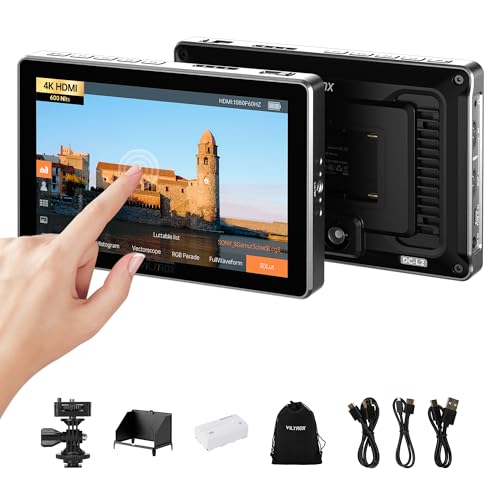
- 7-inch 600-nit touchscreen
- 4K 60Hz HDMI plus SDI input/output
- Includes waveform, false color, peaking, LUT, and de-squeeze tools
Best For: Mobile filmmakers and camera operators needing flexible connectivity
Compact Production Monitoring
FEELWORLD FW703 7-inch SDI Monitor

- 1920×1200 IPS display with Rec.709 color
- HDMI 4K and 3G-SDI connectivity
- Waveform, vectorscope, histogram, peaking, and LUT support
Best For: Indoor shoots and camera-mounted production workflows
Bright Outdoor Pick
VILTROX DC-X3 6-Inch SDI Monitor

- 2000-nit 6-inch Full HD IPS display
- 3G-SDI loop in/out plus 4K HDMI
- Custom 3D LUTs and professional scopes
Best For: Outdoor filmmakers needing a bright, portable SDI monitor
Rugged Production Choice
FEELWORLD SC6 6-Inch SDI Monitor

- 1500-nit display with aluminum housing
- 3G-SDI and 4K/60 HDMI input/output
- Camera power output and professional monitoring tools
Best For: Production crews wanting a durable, versatile on-set monitor
Large-Screen Pro Pick
FEELWORLD LUT11S 10.1-Inch SDI Monitor

- 10.1-inch 1920x1200 IPS display at 2000 nits
- SDI I/O with dual HDMI inputs and HDMI output
- Stores up to 50 custom 3D LUTs
Best For: Production teams needing a large, bright color-monitoring display
Best Sunlight-Readable Pick – VILTROX DC-X3
If you need a field monitor with SDI for bright outdoor shoots, the VILTROX DC-X3 stands out with a genuine 2000-nit display. It combines 3G-SDI and HDMI connectivity with a touchscreen interface and a broad set of exposure, focus, and framing tools.
Best For: Outdoor filmmakers and crews needing maximum screen brightness, flexible power, and professional monitoring tools.
Pros:
- 2000-nit, 6-inch IPS screen is designed for sunlight-readable monitoring.
- Includes 3G-SDI and HDMI input/loop-out connections with support up to 4K at 30Hz.
- Offers waveform, vectorscope, histogram, focus peaking, zebra, false color, and custom 3D LUT support.
- Supports NP-F batteries, DC input, and USB-C PD power.
Cons:
- Its 6-inch screen is smaller than the displays on larger production monitors.
- The listed weight is 1.32 kg, which may be substantial for a compact camera rig.
The DC-X3 is a strong choice when visibility and connectivity matter most. Its high brightness, SDI loop-out, touchscreen controls, and triple-power design make it especially versatile for demanding outdoor and all-day production work.
Best OLED Workflow – NEEWER F700U
The NEEWER F700U is a field monitor with SDI that pairs a large 7-inch OLED touchscreen with 1200-nit brightness and a very high listed contrast ratio. Its HDMI loop-out, 3G-SDI I/O, built-in LUTs, and included NP-F batteries make it well equipped for on-set monitoring.
Best For: Videographers who want an OLED touchscreen, a larger viewing area, and included battery power.
Pros:
- 7-inch 1920×1080 OLED touchscreen offers a spacious monitoring area and 100,000:1 listed contrast ratio.
- Supports 4K HDMI input and loop-out plus 3G-SDI input and output for HD formats up to 1920×1080.
- Includes exposure and focus tools such as waveform, vectorscope, histogram, false color, zebra, and audio levels.
- Comes with two 4400mAh NP-F750 batteries and supports DC or USB-C power.
Cons:
- SDI cable and DC adapter are not included.
- Its 1200-nit brightness is lower than the VILTROX DC-X3’s listed 2000 nits.
Choose the F700U if a larger OLED panel and a ready-to-use battery setup are more important than maximum brightness. It is a practical option for crews that need detailed monitoring, 3G-SDI connectivity, and extensive LUT support.
Best Large Production Monitor – SEETEC P173-9HSD-CO
For productions that need a much larger viewing surface, the SEETEC P173-9HSD-CO is a 17.3-inch field monitor with SDI, HDMI, composite, and component connectivity. Its carry-on design, sunshade, tally lights, and focus-assist features suit studio, broadcast, and video-production setups.
Best For: Broadcast teams and production crews that prioritize a large screen, multiple video formats, and tally functionality.
Pros:
- Large 17.3-inch 1920×1080 display is useful for shared viewing and detailed shot evaluation.
- Provides 3G HD-SDI, HDMI, composite, and component input and output connections.
- Includes focus assist, check field, image freeze, image flip, center marker, safe frame, and color-temperature controls.
- Front and rear three-color tally lights support production-status signaling.
Cons:
- Its 400-nit brightness is less suited to direct sunlight than the brighter compact monitors here.
- The large form factor is less convenient for lightweight camera-mounted use.
- It does not list touchscreen operation or custom LUT support in the supplied specifications.
The P173-9HSD-CO is best viewed as a production or carry-on monitor rather than a small camera accessory. Its generous screen and broad legacy-plus-modern connectivity make it a sensible choice where crew visibility and signal compatibility are priorities.
Best 12G-SDI Compact Pick – FEELWORLD H5
The FEELWORLD H5 is a compact field monitor with SDI built around fast 12G-SDI and 4K HDMI connectivity. Its 1200-nit touchscreen, color-calibrated display, lightweight aluminum body, and included cables make it a convenient option for high-resolution camera rigs.
Best For: DSLR, mirrorless, and camcorder users who need 12G-SDI and 4K monitoring in a lightweight package.
Pros:
- 12G-SDI and HDMI 2.0 support signals up to 4K at 60fps.
- 1200-nit screen is designed for sunlight-readable outdoor viewing.
- Color-calibrated display includes DCI-P3 and Rec.709 color spaces plus support for up to 32 LUT files.
- Lightweight CNC-machined aluminum housing weighs 10.6 ounces and includes HDMI cables and a hot-shoe mount.
Cons:
- The 5.5-inch screen is smaller than the displays on the NEEWER and SEETEC monitors.
- The supplied notes do not specify SDI loop-out functionality.
- Only a single included battery is noted.
The H5 is a compelling fit for mobile rigs that need modern 12G-SDI bandwidth without adding much weight. It is particularly attractive for high-frame-rate 4K work, quick touchscreen operation, and LUT-based color previews.
Bright Studio Monitoring – FEELWORLD FVM215 21.5-inch SDI Monitor
If you need a field monitor with SDI for studio, broadcast, or production setups, the FEELWORLD FVM215 prioritizes a large, bright viewing area. Its 21.5-inch 1000-nit IPS display, 3G-SDI and HDMI connectivity, and built-in exposure and focus tools make it suited to monitoring where screen size and visibility matter.
Best For: Studio productions, broadcast work, and crews that need a large monitor in bright environments.
Pros:
- 1000-nit 21.5-inch display is designed for strong lighting conditions.
- Includes HDMI and 3G-SDI connections for professional cameras and recorders.
- Provides waveform, RGB parade, vectorscope, false color, focus assist, and 3D LUT loading.
- Color calibration is performed with CALMAN software before shipment.
Cons:
- At 9.4 pounds, it is less convenient for lightweight on-camera use.
- Its 1920×1080 native resolution does not provide a 4K display.
- The 25-millisecond response time is not especially fast for a production monitor.
The FVM215 is a practical choice when a bright, full-size monitoring screen is more important than portability. The included V-mount battery plate adds flexibility for compatible mobile setups, while its extensive image-analysis tools support more controlled exposure and focus decisions.
Touchscreen Field Flexibility – VILTROX DC-L2 7-inch SDI Monitor
The VILTROX DC-L2 is a compact field monitor with SDI that combines a 7-inch touchscreen with HDMI and SDI input/output. With 4K 60Hz HDMI support, a detachable sun hood, and a broad set of exposure, focus, framing, and LUT tools, it is built for mobile production workflows.
Best For: Camera operators and filmmakers who want touchscreen control, SDI connectivity, and flexible power options on location.
Pros:
- 7-inch 600-nit IPS touchscreen offers a 170-degree viewing angle.
- Supports up to 4K 60Hz HDMI input/output alongside SDI connectivity.
- Includes waveform, histogram, false color, zebra, focus peaking, LUT preview, and de-squeeze tools.
- Can run from an NP-F battery, USB-C, or DC input; an NP-F550 battery is included.
Cons:
- The 1280×800 display is not a native 4K screen.
- Its 600-nit brightness is lower than some high-brightness production monitors.
- The 7-inch screen provides less viewing area than larger studio monitors.
The DC-L2 offers a strong balance of portability and monitoring control. Its touchscreen, customizable shortcut keys, sun hood, and included carrying accessories make it especially convenient for location work, while the SDI and HDMI combination supports varied camera and video-system setups.
Compact Production Monitoring – FEELWORLD FW703 7-inch SDI Monitor
The FEELWORLD FW703 is a practical field monitor with SDI for DSLR, mirrorless, cinema-camera, and broadcast workflows. Its 7-inch 1920×1200 IPS screen, 3G-SDI and HDMI connectivity, and built-in waveform and focus tools help operators check framing, focus, and exposure during production.
Best For: Filmmakers, camera operators, interview crews, and indoor productions needing a lightweight monitor with SDI.
Pros:
- 7-inch Full HD 1920×1200 IPS display uses Rec.709 color standards.
- Combines HDMI 4K support with 3G-SDI connectivity.
- Includes waveform, vectorscope, RGB histogram, focus peaking, false color, and custom 3D LUT support.
- Weighs 2.42 pounds and is designed for camera, tripod, cage, and hot-shoe setups.
Cons:
- Its 450-nit brightness may be less suitable for harsh outdoor sunlight.
- The supplied notes do not specify a touchscreen interface.
- It is a 7-inch monitor, so it offers less screen area than larger studio models.
The FW703 is a well-rounded option for crews seeking a relatively light SDI monitor with useful image-analysis tools. It is particularly suited to indoor production and camera-mounted workflows where accurate focus, exposure, and framing matter more than maximum outdoor brightness.
Bright Outdoor Pick – VILTROX DC-X3 6-Inch SDI Monitor
If you need a field monitor with SDI for outdoor production, the VILTROX DC-X3 combines a highly visible 2000-nit display with 3G-SDI and 4K HDMI connectivity. Its touchscreen controls, monitoring tools, and included battery make it a practical kit for shooters who need setup flexibility on location.
Best For: Outdoor filmmakers and camera operators who want a bright, compact monitor with SDI loop-through and extensive exposure and focus tools.
Pros:
- 2000-nit, 6-inch Full HD IPS display with a 160-degree viewing angle.
- Supports 3G-SDI signals up to 1080p/60 and 4K HDMI input/output up to 30Hz.
- Includes waveform, vectorscope, histogram, false color, peaking, and custom 3D LUT support.
- Offers NP-F, DC, and compatible USB-C power options; an NP-F550 battery is included.
Cons:
- SDI support is limited to 1080p/60, while HDMI supports higher 4K resolutions.
- The 6-inch screen may provide less viewing area than larger production monitors.
The DC-X3 is a well-rounded choice when daylight visibility and broad monitoring assistance matter most. Its included battery, sunshade, and carrying case also make it convenient for mobile shoots.
Rugged Production Choice – FEELWORLD SC6 6-Inch SDI Monitor
The FEELWORLD SC6 is a field monitor with SDI designed for demanding production environments. Its aluminum housing, 1500-nit screen, and combination of touchscreen and control-knob operation provide a durable, practical setup for handheld, gimbal, and on-set monitoring.
Best For: Filmmakers, videographers, and production teams needing a durable 6-inch monitor for bright locations, interviews, commercial work, or multi-camera setups.
Pros:
- 1500-nit display improves visibility in bright outdoor conditions.
- Provides 3G-SDI and 4K/60 HDMI input/output for flexible signal routing.
- Includes waveform, vectorscope, histogram, zebra, false color, peaking, audio meter, HDR, and 3D LUT tools.
- Supports NP-F batteries and USB-C, and can power a camera through its 8.4V DC output.
Cons:
- The supplied notes do not specify the monitor’s native display resolution.
- Its 1500-nit brightness is lower than the 2000-nit alternatives in this roundup.
Choose the SC6 if rugged construction and flexible production connectivity are higher priorities than maximum brightness. The camera power output and control knob add useful versatility during active shoots.
Large-Screen Pro Pick – FEELWORLD LUT11S 10.1-Inch SDI Monitor
For creators who want a larger viewing area, the FEELWORLD LUT11S is a field monitor with SDI featuring a 10.1-inch 1920×1200 IPS panel and 2000-nit brightness. It adds HDR monitoring, wide color-gamut support, multiple HDMI connections, and custom LUT storage for more detailed on-set evaluation.
Best For: Directors, cinematographers, and production teams who need a large, bright monitor for focus, framing, HDR, and color-look previews.
Pros:
- Large 10.1-inch 1920×1200 IPS display with 2000-nit daylight visibility.
- Includes SDI input/output, dual HDMI inputs, HDMI output, and headphone monitoring.
- Stores up to 50 custom 3D LUTs and supports 3G-SDI LUT loop-out.
- Offers HDR monitoring, camera-specific gamma options, and three customizable buttons.
Cons:
- The larger 1.8-pound design is less compact than a typical 6-inch field monitor.
- Its native resolution is 1920×1200 even though supported input resolution reaches 4K.
The LUT11S is the strongest fit when screen size and advanced color workflow features outweigh portability. Its bright panel, SDI loop-out LUT support, and broad signal connectivity suit more involved on-set monitoring setups.
How We Picked the Best Field Monitor with Sdi
We selected models that combine SDI connectivity with useful production features and practical screen sizes. The lineup includes 3G-SDI and 12G-SDI options, HDMI compatibility, loop-through connections, high-brightness panels, touchscreen controls, and monitoring tools such as waveform displays, focus peaking, false color, and 3D LUT support.
We also considered how each monitor fits a real workflow: compact camera operation, mobile production, director viewing, broadcast carts, and video-assist work. Specifications can vary by configuration, so confirm the exact input, output, resolution, battery, and mounting details before ordering.
Quick Comparison
| Best For | Recommended Type | What to Prioritize |
|---|---|---|
| Camera-top operation | 5.5- to 7-inch monitor | Low weight, touch controls, SDI loop-through, battery compatibility |
| Bright outdoor shoots | 1,200- to 2,000-nit display | High brightness, sun hood support, viewing angle, durable build |
| Broadcast and studio work | 10- to 21.5-inch monitor | Screen size, stable mounting, 3G-SDI, HDMI, and power options |
| 4K production | 12G-SDI or 4K HDMI model | Supported frame rates, signal compatibility, scaling, and loop outputs |
Key Buying Factors for a Field Monitor with Sdi
SDI Standard and Signal Compatibility
Check whether the monitor supports 3G-SDI or 12G-SDI and match that specification to your camera, switcher, recorder, and cable infrastructure. Also verify whether the SDI connection is an input, output, or loop-through. A monitor may advertise 4K HDMI while accepting only HD signals over SDI.
Brightness and Screen Size
For outdoor filming, a 1,000-nit-or-brighter panel is generally more practical than a conventional 400- to 500-nit display. Larger screens improve shared viewing and composition checks but add weight and require more mounting space. A 5.5- or 7-inch monitor is usually easier to mount on a camera rig.
Monitoring Tools
Look for tools that support exposure and focus decisions, including waveform, vectorscope, histogram, zebra, false color, focus peaking, anamorphic de-squeeze, and LUT loading. Touchscreen operation can speed up adjustments, though physical buttons may be preferable when wearing gloves.
Power, Mounting, and Durability
Confirm the battery plate or DC input, expected runtime, power draw, mounting points, and included accessories. For frequent travel, prioritize a robust housing and manageable weight. For fixed installations, power flexibility and reliable signal pass-through may matter more than portability.
Who Should Buy Which Field Monitor with Sdi?
Choose a compact 5.5- to 7-inch model if you need a camera-top display for handheld, gimbal, or tripod work. Choose a high-brightness monitor if you regularly shoot in daylight and need to judge focus and exposure without relying on a hood. A larger 10.1- to 21.5-inch display is better for directors, clients, studio crews, and video-assist stations. For 4K SDI workflows, prioritize 12G-SDI support; for many HD broadcast setups, a dependable 3G-SDI monitor may provide everything required at a lower cost.