Old negatives and slides can hold irreplaceable family memories, but viewing and sharing them becomes difficult as film ages. The right scanner can turn those originals into convenient digital files while preserving far more detail than a quick phone photo.
We selected 10 options covering easy all-in-one scanners, portable smartphone digitizers, and color-managed models for photographers who want greater control over image quality.
Best 10 Film Scanners for Old Negatives Picks for 2026
Best All-in-One Display
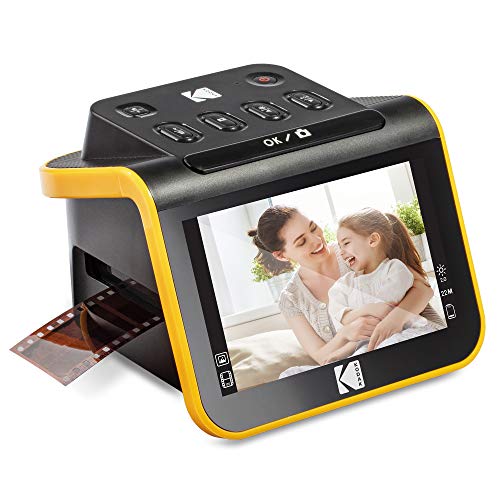
- Scans 135, 110, 126, and 50mm slide formats
- 5-inch LCD with gallery and editing functions
- Saves directly to SD or SDHC cards
Best For: Mixed-format home photo archiving
Best for Color Accuracy
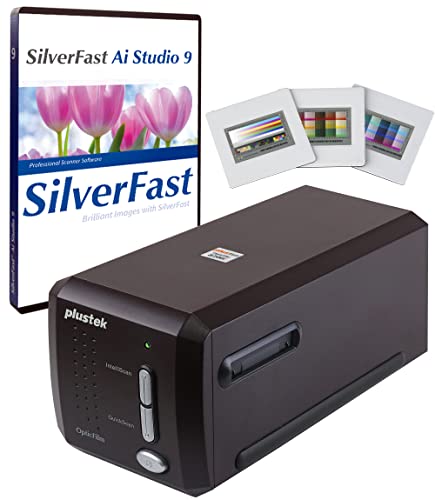
- 7200-resolution CCD scanner for 35mm film
- Includes SilverFast 9 and an IT8 calibration target
- Advanced infrared and HDRi processing tools
Best For: Careful 35mm archival scanning
Best No-Computer Option

- Converts several negative, slide, and Super 8 formats
- No computer or driver installation required
- Scans in under five seconds and supports 128GB SD cards
Best For: Fast, beginner-friendly home scanning
Best for Large-Scale Viewing

- Large 7-inch tiltable LCD display
- Quick-feeding tray supports continuous scanning
- Handles 135, 110, and 126 film
Best For: Large family collections and easy previewing
Best Overall

- 24MP CMOS scanning
- Large 7-inch LCD
- SD card included
Best For: Standalone scanning of mixed film formats
Best Touchscreen Option
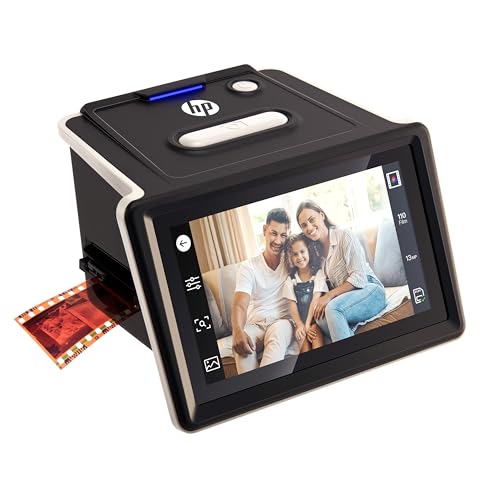
- 5-inch touchscreen LCD
- Standalone scanning workflow
- Quick-load tray for batches
Best For: Touchscreen-controlled scanning of 135, 126, and 110 film
Best Format Flexibility
KODAK SCANZA Film & Slide Scanner
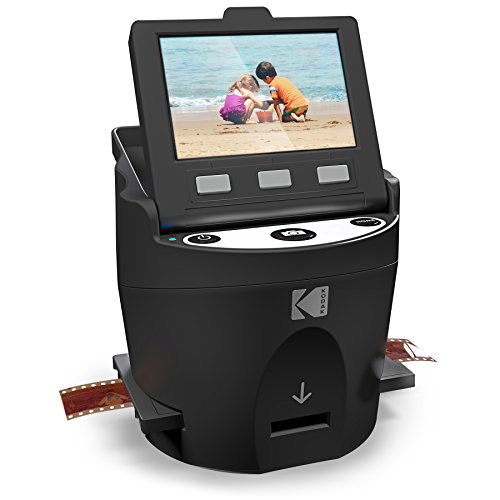
- Supports five film formats
- Multiple adapters included
- USB and HDMI connectivity
Best For: Mixed archives including Super 8 and 8mm
Best Portable Pick
DigitPro M301 Smartphone Film Scanner

- Scans 35mm negatives and slides with a smartphone
- Foldable design with built-in battery and phone holder
- Includes free editing app and starter accessories
Best For: Beginners and families digitizing 35mm film
Best Standalone Option
ClearClick QuickConvert 2.0 Film Scanner
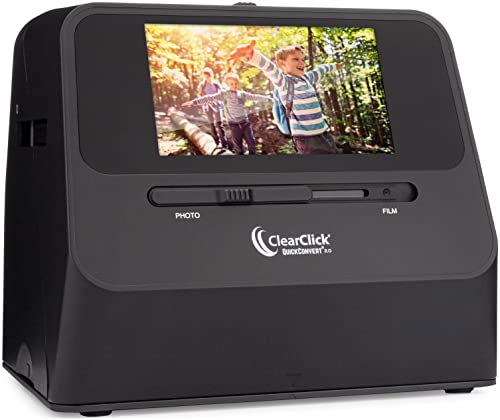
- Scans 35mm, 110, and 126 film plus small photos
- Works without a computer and saves JPEGs to SD card
- Includes rechargeable battery, preview LCD, and two-year warranty
Best For: Computer-free scanning across multiple film formats
Best Simple Smartphone Pick

- Captures 35mm negatives and slides with a smartphone
- Folds compactly for storage and travel
- Free app includes basic editing and sharing tools
Best For: Casual, portable 35mm film digitizing
Best All-in-One Display – KODAK Slide N Scan 22MP
For shoppers comparing film scanners for old negatives, the KODAK Slide N Scan offers a convenient, computer-light workflow. It handles 135, 110, and 126 negatives plus 50mm slides, previews scans on its 5-inch LCD, and saves files directly to an SD or SDHC card.
Best For: Families digitizing mixed-format negatives and slides with an on-device display and simple controls.
Pros:
- Supports 135, 110, and 126 film formats, along with 50mm slides.
- Large 5-inch LCD provides preview, editing, and gallery viewing.
- Includes film adapters, a cleaning brush, USB cable, and HDMI cable.
- Offers one-touch adjustments for film type, color, brightness, and date/time.
Cons:
- SD or SDHC card is not included and capacity is limited to 32GB.
- Its editing controls are designed for convenience rather than advanced image processing.
This is a practical choice when ease of use and broad format support matter more than professional scanning controls. The built-in screen and direct-to-card saving make it especially suitable for casual home archiving.
Best for Color Accuracy – Plustek OpticFilm 8300i Ai
Among film scanners for old negatives, the Plustek OpticFilm 8300i Ai is the most technically focused option in this group. It is built for 35mm slides and uses a CCD sensor, 7200 resolution, calibration software, infrared cleaning features, and a supplied IT8 target for more controlled results.
Best For: Enthusiasts and archivists scanning 35mm film who want detailed software-based control and color calibration.
Pros:
- 7200-resolution CCD scanning with 16-bit color and grayscale depth.
- Includes SilverFast 9 Ai Studio and Plustek Quick Scan Plus software.
- Built-in infrared, HDRi, Multi-Exposure, histogram, and NegaFix tools support advanced processing.
- Includes an ISO 12641-2-compliant IT8 calibration target.
Cons:
- Supports 35mm slides rather than a broad range of film formats.
- Requires a USB-connected computer and software setup.
- Its advanced controls may be more than casual users need.
The OpticFilm 8300i Ai is better suited to deliberate, high-control scanning than quick, screen-only conversion. Choose it when 35mm quality and calibration matter more than portability or simplicity.
Best No-Computer Option – Magnasonic FS71 24MP
The Magnasonic FS71 is a straightforward pick among film scanners for old negatives when speed and convenience are priorities. It converts 35mm, 110, 126, and Super 8 negatives, plus 135, 126, and 110 slides, then saves JPEG files to an SD card without requiring a computer or separate editing software.
Best For: Beginners who want fast, standalone scanning with broad format support.
Pros:
- Supports 35mm, 110, 126, and Super 8 negatives, plus multiple slide formats.
- Scans can be completed in less than five seconds each according to the supplied product notes.
- Built-in 5-inch display supports previewing and direct adjustments.
- SD card slot supports up to 128GB of expandable memory.
Cons:
- SD card is not included.
- HDMI cable for TV or monitor viewing is not included.
- On-device adjustments are convenient but not a substitute for advanced desktop editing.
With its standalone operation, fast-loading trays, and wide film compatibility, the FS71 is a strong fit for large personal collections. It favors an uncomplicated workflow over professional calibration or extensive computer-based controls.
Best for Large-Scale Viewing – KODAK Slide N Scan Max
The KODAK Slide N Scan Max is a convenient choice for scanning film at home, particularly when a larger preview screen is useful. It supports 135, 110, and 126 film, uses a quick-feeding tray for continuous scanning, and saves digital files directly to SD or SDHC cards up to 32GB.
Best For: Users digitizing family slide and negative collections who want a large tilting display and simple operation.
Pros:
- 7-inch tiltable LCD makes previews, editing, and sharing easier.
- Quick-feeding tray supports a smoother continuous scanning workflow.
- Handles 135, 110, and 126 film formats.
- One-touch tools resize, convert, and adjust images without complex menus.
Cons:
- SD or SDHC card is not included and storage support is limited to 32GB.
- Uses a USB connection rather than listing HDMI connectivity in the supplied details.
- The supplied notes do not specify support for Super 8 film.
The Slide N Scan Max stands out for its generous screen and efficient tray design. It is a sensible option for convenient family archiving, especially when you want to review scans directly on the device.
Best Overall – BEONEGLOBAL ClearScan P7
For shoppers comparing film scanners for old negatives, the BEONEGLOBAL ClearScan P7 stands out for its large display, broad format support, and included SD card. It scans without a computer and offers adjustable image framing for a more convenient workflow.
Best For: Users who want a large-screen, standalone scanner for mixed film formats.
Pros:
- 7-inch LCD supports comfortable previews and image browsing.
- Scans at up to 24MP with a 1/2.3-inch CMOS sensor.
- Supports 35mm/135, 126, 110, Super 8, and 8mm film and slides.
- Includes a branded SD card for saving scans out of the box.
Cons:
- The notes do not specify the supported SD card capacity.
- USB is listed as the connection type, but standalone operation is the primary workflow described.
The P7 is a practical pick when ease of use and screen size matter most. Its one-touch controls and included storage reduce setup friction, while the format compatibility helps with varied family archives.
Best Touchscreen Option – HP FilmScan HPFS500
The HP FilmScan HPFS500 is a compact choice for film scanners for old negatives, especially if you prefer touchscreen controls. Its standalone design, quick-load tray, and support for several common formats make it suitable for organizing a mixed collection.
Best For: Users who want touchscreen editing and faster transitions between scans.
Pros:
- 5-inch all-angle LCD touchscreen enables direct preview and editing.
- Works without a computer during the digitization workflow.
- Supports 135, 126, and 110 negatives and positive slides.
- Quick-load tray helps streamline batch scanning.
Cons:
- Its 13MP CMOS sensor with 22MP interpolation is lower than the 24MP rating of some alternatives.
- The supplied notes do not list support for Super 8 or 8mm film.
- SD card storage is supported, but an included card is not specified.
The HPFS500 prioritizes hands-on operation and collection throughput. Choose it if a touchscreen interface and quick-loading tray are more important to you than the widest format coverage or highest stated resolution.
Best Format Flexibility – KODAK SCANZA Film & Slide Scanner
The KODAK SCANZA is a versatile option among film scanners for old negatives, with adapters for multiple film types and a simple one-touch scan-and-save process. It connects through USB or HDMI and includes several useful cables plus a cleaning brush.
Best For: Users digitizing 35mm, 126, 110, Super 8, and 8mm negatives or slides.
Pros:
- Supports 35mm, 126, 110, Super 8, and 8mm film and slides.
- Includes multiple film inserts and adapters.
- 3.5-inch adjustable-brightness LCD tilts for easier viewing.
- Includes USB, HDMI, AC, and video cables plus a film-cleaning brush.
Cons:
- SD card is not included.
- The display is smaller than the 7-inch screen on the BEONEGLOBAL model.
- The supplied notes specify that it will not convert film types outside the listed formats.
SCANZA makes the most sense for households with several supported film formats and a need for flexible connectivity. Remember to budget for an SD card, and use the included brush to help reduce dust and speckles during scanning.
Best Portable Pick – DigitPro M301 Smartphone Film Scanner
For shoppers seeking film scanners for old negatives without bulky equipment, the DigitPro M301 offers a simple smartphone-based approach. It handles 35mm black-and-white and color negatives plus slides, and its foldable design makes it convenient for occasional home or travel use.
Best For: Beginners and families digitizing 35mm film with a smartphone.
Pros:
- Supports 35mm negatives, positives, and slides.
- Foldable, lightweight design with a built-in battery and phone holder.
- Includes a free editing app, cleaning cloth, phone clip, battery, and illustrated manual.
Cons:
- Requires a smartphone camera to capture images.
- Limited to 35mm film formats.
The M301 is a practical choice when portability and ease of use matter more than standalone scanning hardware. Its included accessories and guided setup make it approachable for first-time users.
Best Standalone Option – ClearClick QuickConvert 2.0 Film Scanner
The ClearClick QuickConvert 2.0 is a versatile option among film scanners for old negatives, especially if you want to scan without a computer. It converts 35mm, 110, and 126 negatives and slides, as well as 4×6 photos or smaller, directly to JPEG files on an SD card.
Best For: Users who want computer-free scanning across several film formats and small prints.
Pros:
- Supports 35mm, 110, and 126 film, slides, and 4×6 photos or smaller.
- Requires no computer or drivers and saves JPEGs to an SD card.
- Built-in rechargeable battery and 5-inch preview LCD support cordless scanning.
- Scans in about 2–3 seconds per item and includes a two-year warranty.
Cons:
- Does not have an automatic feeder; items must be scanned one at a time.
- Does not support 5×7 photos.
- The stated 22-megapixel figure is interpolated from a 14-megapixel scan.
With broader format support and a built-in screen, the QuickConvert 2.0 is more self-contained than smartphone-based models. Its one-at-a-time workflow is best suited to personal collections rather than high-volume scanning.
Best Simple Smartphone Pick – TCNEWCL Foldable 35mm Scanner
The TCNEWCL foldable scanner is a straightforward choice among film scanners for old negatives when you already have a smartphone. Its LED backlight and compact housing help you capture 35mm slides and negatives, while the free app provides basic editing and sharing tools.
Best For: Casual users who want an inexpensive, portable way to capture 35mm film with a phone.
Pros:
- Designed for 35mm slides and film negatives.
- Folds into a compact form for storage and travel.
- Free app supports cropping, rotation, filters, color and contrast adjustments, and sharing.
Cons:
- Image quality depends on the resolution of the smartphone camera.
- Limited to 35mm media.
- Requires a smartphone and app-based capture process.
This model keeps the digitizing process simple and portable, making it suitable for occasional projects or family photo collections. Choose it when convenience matters more than independent operation or advanced scanning controls.
How We Picked the Best Film Scanners for Old Negatives
We evaluated these scanners by looking at film-format support, advertised resolution, preview-screen size, connection and storage options, ease of use, and the type of user each model is designed to serve. We also considered whether a scanner works independently or requires a computer, since that difference has a major effect on convenience.
Advertised megapixel counts are not the only measure of quality. Lens performance, sensor consistency, dust on the film, software controls, and the quality of the original negative all affect the final image. Treat the listed resolution as a comparison point rather than a guarantee of professional results.
Quick Comparison
- Best for straightforward home scanning: An all-in-one KODAK, Magnasonic, BEONEGLOBAL, or ClearClick model with a built-in display.
- Best for higher-end 35mm work: The Plustek OpticFilm 8300i Ai, especially when color accuracy and detailed scans matter.
- Best for multiple film formats: Models supporting 35mm, 110, 126, Super 8, and 8mm formats.
- Best for portability: A foldable smartphone film scanner that uses an LED backlight and your phone’s camera.
- Best for simple computer transfers: A USB-connected model such as the HP Film & Slide Scanner.
Key Buying Factors for Film Scanners for Old Negatives
Film-Format Compatibility
Check the exact film types in your collection before buying. Most home scanners handle 35mm film, but 110, 126, Super 8, and 8mm support varies. Slide holders and negative holders may also differ in capacity and fit.
Resolution and Image Quality
Higher advertised resolution can help with cropping and enlargements, but it does not automatically create sharper images. For occasional family archiving, a convenient 20MP-to-24MP scanner may be sufficient. Photographers seeking more detail, accurate color, or extensive editing should consider a dedicated film scanner with better optics and software.
Workflow and File Transfer
Standalone scanners with LCD screens and memory-card support are convenient for batch scanning without a computer. USB models may offer a more direct workflow, while smartphone digitizers are compact but depend heavily on phone-camera quality, alignment, and editing apps.
Handling and Preservation
Look for holders that keep film flat and aligned. Clean negatives gently before scanning, avoid touching the image surface, and store originals in archival sleeves after digitizing them. Built-in dust removal can help, but careful preparation remains important.
Who Should Buy Which Film Scanners for Old Negatives?
Choose an all-in-one desktop scanner if you want a simple process, a preview screen, and the ability to scan several common film formats without learning specialized software.
Choose the Plustek if you have a large 35mm collection and care more about detail, color control, and editing flexibility than fast, one-button operation.
Choose a portable smartphone model if storage space, low cost, and occasional scanning matter most. It is a practical solution for quick sharing, but it may not match a dedicated scanner for consistency or archival quality.
Choose a photo-and-film model if you also need to digitize printed photographs. These units can reduce the number of devices in your workspace, though dedicated film scanners generally offer a more focused workflow.