Digitizing a box of family prints is much easier with a scanner designed for batch work. The right model can feed multiple photos, handle mixed document jobs, and apply useful image corrections without turning the process into an all-day project.
This roundup compares 10 photo and document scanners across feeder speed, image quality, connectivity, media support, and ease of use, so you can choose the best fit for occasional preservation or a larger archive.
Best 10 Photo Scanners with Batch Scanning Picks for 2026
Best Overall

- Batch-scans up to 36 photos
- Captures fronts and handwritten backs
- Wi-Fi, OCR, and restoration tools
Best For: Large photo collections and mixed photo-document scanning
Best Compact Option

- Scans 4x6 photos in about 2 seconds
- Supports photos up to 8x10
- Includes one-click enhancement tools
Best For: Simple, sequential home photo scanning
Best Legacy High-Volume Pick
- Feeds up to 30 photos at once
- Scans at up to 1 photo per second
- Handles photos up to 600 dpi
Best For: Large wired photo-archiving projects
Best for Mixed Documents

- Scans up to 40 pages per minute
- Supports duplex and continuous scanning
- Handles photos, receipts, and cards
Best For: Office workflows with varied documents and occasional photos
High-Detail Film and Photo Scanning

- Up to 6400 dpi resolution
- Dual-lens system for photos and film
- 48-bit color and 4.0 Dmax
Best For: Detailed photo, slide, and film archiving
Fast Automatic Document Batching

- 50-sheet automatic feeder
- 30 ppm duplex scanning
- Handles paper and plastic cards
Best For: High-volume office document and card scanning
Easy Photo and Film Restoration
Epson Perfection V500 Photo Scanner

- 6400 dpi photo and film scanning
- 10-sheet standard capacity
- Easy Photo Fix and Digital ICE
Best For: Home photo, slide, and negative digitization
Best Wireless Upgrade

- Scans up to 100 photos per minute
- Includes carrier sheets and a 36-photo capacity
- Offers Wi-Fi 6, USB-C, touchscreen profiles, and cloud support
Best For: Fast, connected photo archiving and organization
Best for Film and Restoration
Epson Perfection V550 Photo Scanner

- 6400 dpi optical resolution and 48-bit color depth
- Scans slides, negatives, film, and multiple photos at once
- Includes Digital ICE and one-touch photo restoration features
Best For: Detailed photo, negative, and slide preservation
Best Overall – Epson FastFoto FF-680W
If you need photo scanners with batch scanning, the Epson FastFoto FF-680W is a strong all-purpose choice. It can batch-scan up to 36 photos, scan at up to one photo per second at 300 dpi, and handle mixed photo sizes in one batch.
Best For: Families digitizing large photo collections while also scanning documents.
Pros:
- Batch-scans up to 36 photos and supports speeds up to 1 photo per second at 300 dpi.
- Duplex scanning captures photos and handwritten notes on the back in one pass.
- Includes auto enhancement, color restoration, red-eye reduction, cropping, rotation, and de-skew.
- Offers Wi-Fi and USB connectivity plus OCR document scanning.
Cons:
- Heavier and larger than compact single-photo scanners.
- Its standard sheet capacity is listed as 10, despite the larger photo batch capability.
The FF-680W is the most versatile option here for high-volume photo preservation, especially when wireless sharing, duplex capture, and document scanning matter.
Best Compact Option – Plustek ePhoto Z300
The Plustek ePhoto Z300 is a straightforward choice for photo scanners with batch scanning when you want to digitize photos one after another without using a flatbed. It scans a 4×6 photo in about two seconds at 300 dpi and supports several common photo sizes.
Best For: Users seeking a simple USB scanner for steady home photo digitization.
Pros:
- Scans 4×6 photos in about 2 seconds and 8×10 photos in about 5 seconds at 300 dpi.
- Supports 3×5, 4×6, 5×7, 8×10, letter, and A4 media.
- Offers up to 600 dpi optical resolution.
- Includes image-enhancement tools for restoring faded photos.
Cons:
- Photos must be inserted one at a time rather than loaded into an automatic batch feeder.
- USB connectivity only.
The Z300 is efficient for repetitive scanning and easier to use than a flatbed, but it is less suitable for hands-off, feeder-based batch processing.
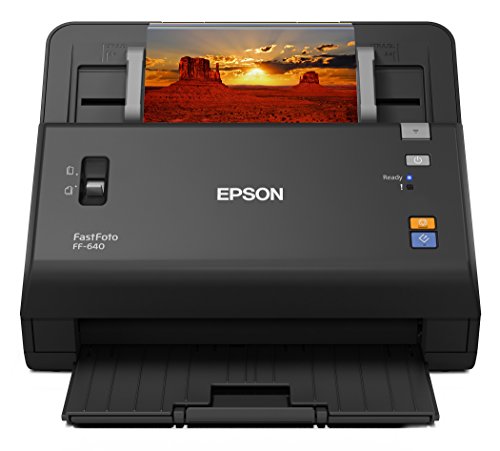
Best Legacy High-Volume Pick – Epson FastFoto FF-640
The Epson FastFoto FF-640 is designed for high-volume photo projects and remains a practical candidate among photo scanners with batch scanning. Its auto-feed tray holds up to 30 photos, and it can scan at up to one photo per second under the stated test conditions.
Best For: Users digitizing thousands of standard and panoramic photos over a wired USB connection.
Pros:
- Auto-feed tray accommodates up to 30 photos at a time.
- Scans at up to one photo per second in the specified 300 dpi test.
- Supports scans up to 600 dpi and photo sizes from wallets to panoramas.
- Includes a carrier sheet and cleaning cloth for photo handling.
Cons:
- USB 2.0 connectivity only.
- Designed as a photo scanner rather than a multifunction document scanner.
The FF-640 is a focused high-volume photo digitizer with a larger feeder than the Z300, making it a better fit for organized archival projects that do not require wireless features.
Best for Mixed Documents – Brother ImageCenter ADS-2800W
The Brother ImageCenter ADS-2800W is primarily a document scanner, but it can suit photo scanners with batch scanning when your workload includes receipts, cards, and multi-page paperwork. It scans single- and double-sided materials in one pass at up to 40 pages per minute.
Best For: Offices that need batch document scanning with occasional photos and varied media.
Pros:
- Scans single- and double-sided materials in one pass at up to 40 pages per minute.
- Handles photos, documents, receipts, business cards, and embossed plastic cards.
- Offers a 50-sheet standard capacity and continuous scan mode.
- Supports wireless direct scanning to cloud applications through Web Connect.
Cons:
- Resolution is listed at 300 dpi, lower than the dedicated photo scanners here.
- It is designed primarily for documents rather than photo restoration or archival detail.
- Supplied connection details list Ethernet and USB, while wireless features depend on the stated networking functions.
The ADS-2800W is the practical choice when batch productivity and media flexibility matter more than specialized photo preservation or high-resolution imaging.
High-Detail Film and Photo Scanning – Epson Perfection V800
For photographers who want photo scanners with batch scanning potential for mixed film and print projects, the Epson Perfection V800 emphasizes image quality. Its dual-lens system, CCD sensor, and support for photos and slides make it a strong choice for careful archival work, although its standard sheet capacity is only one.
Best For: Photographers digitizing prints, slides, and other film media who prioritize tonal detail and color accuracy.
Pros:
- Up to 6400 dpi resolution for detailed scans
- 4.0 Dmax supports smooth gradations and shadow detail
- Dual-lens system selects a lens for the scanning task
- Supports photo and slide media with 48-bit color depth
Cons:
- Standard sheet capacity is limited to one sheet
- At 20.9 pounds, it is relatively heavy
- USB connectivity may be less convenient than wireless scanning
The V800 is best suited to quality-focused users rather than high-volume document workflows. Its film support and high-resolution optical system make it a compelling option for preserving detailed originals.
Fast Automatic Document Batching – Ambir ImageScan Pro 830ix-AS
If your priority is photo scanners with batch scanning for stacks of paper or cards, the Ambir ImageScan Pro 830ix-AS offers a 50-sheet automatic document feeder and 30 ppm duplex scanning. It is designed for documents rather than photographic film, but its compact footprint and card handling suit organized digitization tasks.
Best For: Offices scanning batches of documents, business cards, IDs, insurance cards, and double-sided pages.
Pros:
- 50-sheet feeder supports bulk scanning
- Duplex scanning captures both sides in one pass
- Handles paper, business cards, IDs, insurance cards, and plastic cards
- Compact design and enhanced TWAIN driver support
Cons:
- Document scanner rather than a dedicated photo or film scanner
- USB connection requires a wired setup
- Requires Windows 7 or later according to the listed system requirements
The 830ix-AS is the most batch-oriented option in this group. Choose it when feeder capacity and fast two-sided document capture matter more than film scanning or photographic restoration.
Easy Photo and Film Restoration – Epson Perfection V500 Photo Scanner
The Epson Perfection V500 is a practical choice for photo scanners with batch scanning needs involving small groups of prints, slides, or negatives. It combines 6400 dpi scanning with Easy Photo Fix and Digital ICE, while its 10-sheet standard capacity offers more convenient multi-page handling than a single-sheet flatbed.
Best For: Home users digitizing photos, slides, negatives, and medium-format film with straightforward restoration tools.
Pros:
- 6400 dpi resolution supports detailed enlargements
- Scans photos, slides, negatives, and medium-format film
- Easy Photo Fix restores faded photos with one touch
- Digital ICE helps remove dust and scratches
Cons:
- USB connectivity limits setup flexibility
- Listed minimum system requirement is Windows 7
- It is a flatbed scanner rather than a high-speed ADF model
The V500 balances film capability and user-friendly restoration features. Its 10-sheet capacity can help with small batches, but users processing large document volumes should consider an automatic feeder instead.
Best All-Around Feeder – Canon imageFORMULA RS40
For shoppers comparing photo scanners with batch scanning, the Canon imageFORMULA RS40 is a practical choice for mixed photo and document projects. Its automatic feeder scans both sides at once and handles up to 40 items per minute, while supporting photos, Polaroids, receipts, cards, IDs, and tax documents.
Best For: Families and home users digitizing batches of varied-size photos alongside everyday paperwork.
Pros:
- Automatic feeder holds up to 60 sheets and scans up to 40 items per minute.
- Duplex scanning captures both sides of photos and documents in one pass.
- Bundled software includes photo enhancement, red-eye correction, and face smoothing.
- Supports Windows and Mac and saves to JPG, TIF, BMP, PNG, PDF, and PPTX.
Cons:
- USB is the listed connection, with no wireless option noted.
- The 1200 dpi setting is interpolated rather than optical.
The RS40 stands out when speed, flexible media handling, and simple batch feeding matter more than film scanning or wireless workflows. Its one-year warranty and US-based technical support add reassurance for home archiving projects.
Best Wireless Upgrade – ScanSnap iX2500 Photo Edition
The ScanSnap iX2500 Photo Edition is designed for people who want photo scanners with batch scanning plus a modern wireless workflow. It can scan up to 100 photos per minute, includes three photo carrier sheets for delicate prints, and connects through Wi-Fi 6 or USB-C.
Best For: Users managing larger photo collections who want touchscreen controls, wireless scanning, and cloud or mobile support.
Pros:
- Scans up to 100 photos per minute.
- Its feeder holds up to 100 documents or up to 36 photos.
- Wi-Fi 6 and USB-C support connections to computers, mobile devices, and cloud services.
- Automatic optimization, naming, sorting, and customizable touchscreen profiles simplify organization.
Cons:
- The photo feeder capacity is lower than the document capacity at up to 36 photos.
- Its listed operating-system requirements are relatively current, including macOS Monterey 12 or later.
With its high stated photo speed, carrier sheets, and flexible connectivity, the iX2500 is a strong fit for larger archiving sessions. Choose it over a basic USB model if wireless access and automated file organization are priorities.
Best for Film and Restoration – Epson Perfection V550 Photo Scanner
The Epson Perfection V550 takes a different approach to photo scanners with batch scanning: it uses a flatbed to scan multiple photos at once while also supporting 35mm slides, negatives, and film. Its 6400 dpi optical resolution, 48-bit color depth, and restoration features make it suited to detail-focused archival work.
Best For: Users digitizing prints, negatives, and slides who prioritize resolution and restoration tools over automatic feeder speed.
Pros:
- 6400 dpi optical resolution supports detailed enlargements up to 17 by 22 inches.
- Built-in transparency unit scans 35mm slides, negatives, and film.
- Digital ICE helps reduce the appearance of dust and scratches on film.
- Can scan multiple photos at once, automatically crop each image, and save separate files.
Cons:
- It has a flatbed design with a listed standard sheet capacity of one, so it is not an automatic feeder scanner.
- Connectivity is limited to Hi-Speed USB 2.0 in the supplied specifications.
- The supplied minimum system requirement lists Windows 7, without newer operating-system details.
The V550 is best for careful preservation projects involving film and older prints rather than rapid stacks of loose documents. Its film capability, high optical resolution, and batch photo cropping make it especially versatile for traditional photo collections.
How We Picked the Best Photo Scanners with Batch Scanning
We focused on scanners that can process multiple photos or documents in a workflow rather than requiring one item at a time on a flatbed. The selection includes dedicated photo feeders, automatic document feeders, wireless office scanners, and flatbed models that are better suited to delicate originals, film, negatives, or unusually sized media.
We also considered scan speed, feeder design, duplex capability, optical resolution, software features, connectivity, operating-system support, and the type of originals each scanner can safely handle. A fast document ADF is not automatically the best choice for loose vintage prints, so the recommendations are designed for different scanning priorities.
Quick Comparison
| Best For | Look For | Why It Matters |
|---|---|---|
| Large photo collections | Dedicated photo feeder and high throughput | Reduces manual loading and speeds archive projects |
| Mixed photos and documents | ADF, duplex scanning, and image optimization | Handles everyday paperwork alongside prints |
| Film and negatives | Flatbed with transparency support | Provides the hardware needed for film originals |
| Wireless workflows | Wi-Fi and network scanning | Makes it easier to scan to multiple computers or devices |
Key Buying Factors for Photo Scanners with Batch Scanning
Feeder Capacity and Media Handling
Check how many photos the feeder accepts and whether it supports the sizes you actually own. Dedicated photo feeders are generally preferable for loose prints, while office ADFs are useful for documents and standardized paper. For curled, fragile, sticky, or irregular photos, a flatbed may be safer.
Speed and Duplex Scanning
Advertised pages or photos per minute are useful for comparing models, but real-world results depend on resolution, color mode, file format, and correction settings. Duplex scanning is valuable for documents with information on both sides, though it may not be relevant to a photo-only archive.
Image Quality and Resolution
Higher optical resolution is important for enlargements, cropping, film, and negatives. For ordinary prints, extreme resolution can create larger files without a visible benefit. Look for dust and color correction, automatic cropping, rotation, and blank-page removal when productivity matters.
Software, Connectivity, and File Management
Confirm compatibility with your Windows or Mac setup and check whether the software supports searchable PDFs, automatic naming, cloud destinations, or batch enhancement. Wi-Fi can simplify shared use, while USB is often reliable for a single dedicated workstation.
Who Should Buy Which Photo Scanners with Batch Scanning?
Choose a dedicated high-speed photo feeder when you have hundreds or thousands of loose prints and want the fastest preservation workflow. Select an ADF document scanner if your archive includes paperwork, receipts, and double-sided pages as well as photos. A flatbed photo scanner is the better choice for negatives, slides, artwork, fragile originals, and maximum control over each scan.
For occasional family scanning, prioritize simple software and dependable automatic cropping over headline speed. For a serious digitization project, compare feeder capacity, sustained throughput, file-management tools, and whether replacement rollers or service support are available. Before buying, verify the scanner’s supported photo sizes and the condition of your originals to avoid choosing a fast model that cannot safely handle your collection.